

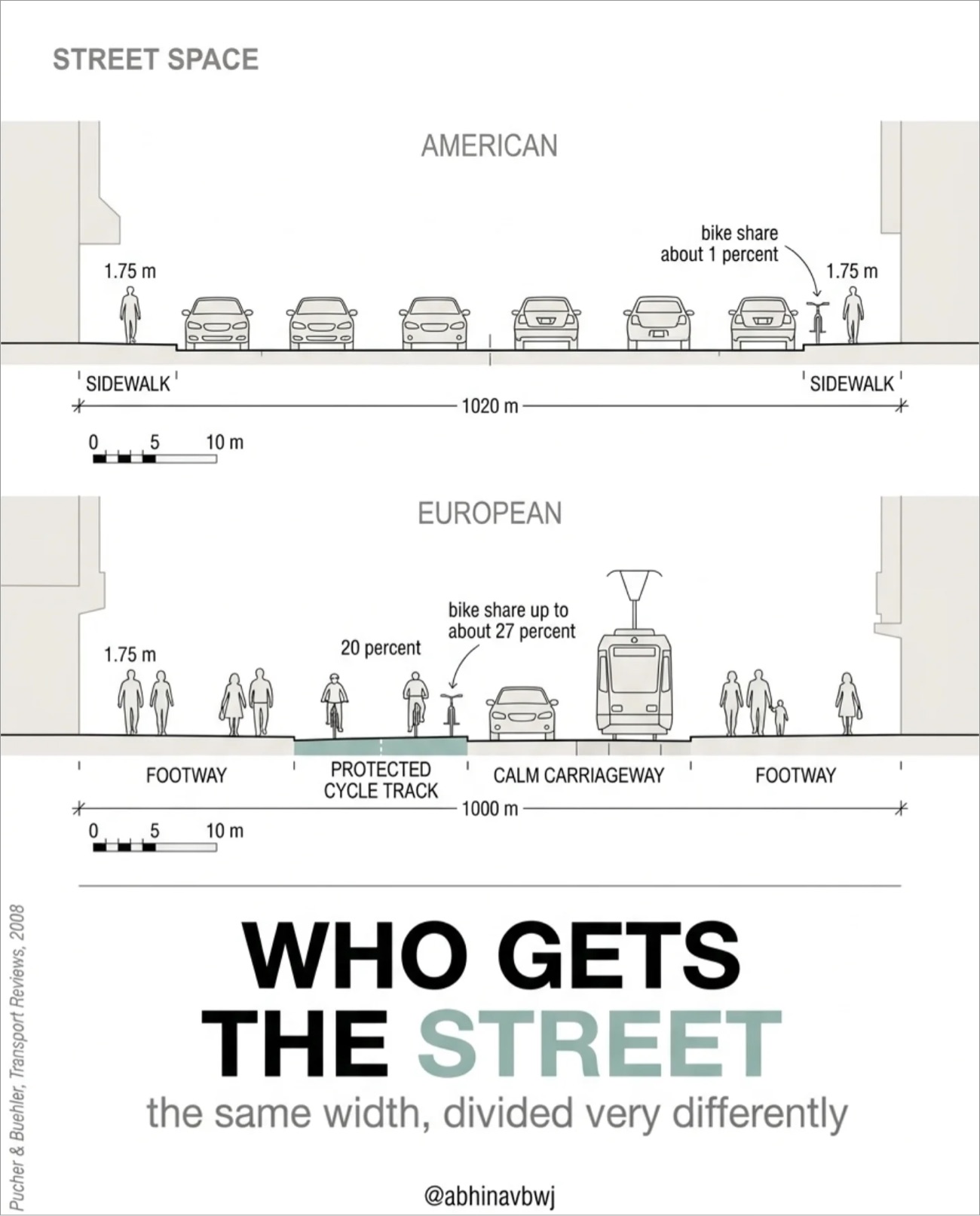
Architect and urban & computational designer Abhinav Bhardwaj made this great set of slides comparing urban design in the US and Europe, peppered with pithy observations like:
- European space is shaped on purpose: American open space is what’s left over.
- Small blocks make more corners, more routes, more street life.
- A fine grid offers hundreds of routes; the tree offers one way out.
Almost no streets are 100 m wide. Maybe it was originally in inches and the author didn’t bother to convert units?
1000 x 0.0254 yields about 25.4 m, which would be pretty reasonable. Let’s assume that all lanes are 4 m wide, which would be much more than normal. (Usually, they’re closer to 3 m wide each, which would yield about 20 m; 2 m is included for the kerbs to separate traffic).
Then with 6 lanes (2 mainwalks, 2 bicycle lanes, 1 car lane + carriageway), you’d have 24 m. Give 1.4 m for some kerbs and then you get the 25.4 m.
@zaphod@sopuli.xyz , @Successful_Try543@feddit.org , I think I have the answer.^
Not all streets are like that, by the way. All of them have side/mainwalks, but not all have the other lanes. Within European cities, the streets are usually closer to 10 m wide.
You right, 100 meters isn’t reasonable. I’ve had about 3h of sleep in the last 48 or so, so my brain is a bit mush. 😆
tbf katy freeway is over 100m wide in some parts. but hopefully that is rare, and probably is ‘unreasonable’.
Those dudes need some more trains over there.
Fun facts: The Katy Freeway goes to Katy, Texas, and Katy, Texas is a southern terminus of the Katy Railroad (formally the Missouri, Kansas and Texas railroad, or “MKT”). The Katy was a major passenger railroad once upon a time.
So in a way, the freeway is helping motorists get to the trains, just trains that are in the past.
That’s a freeway though, I suppose.
sib??? get some sleep dawg
Sib?
Yeah I slept well this night. No worries. 😊