
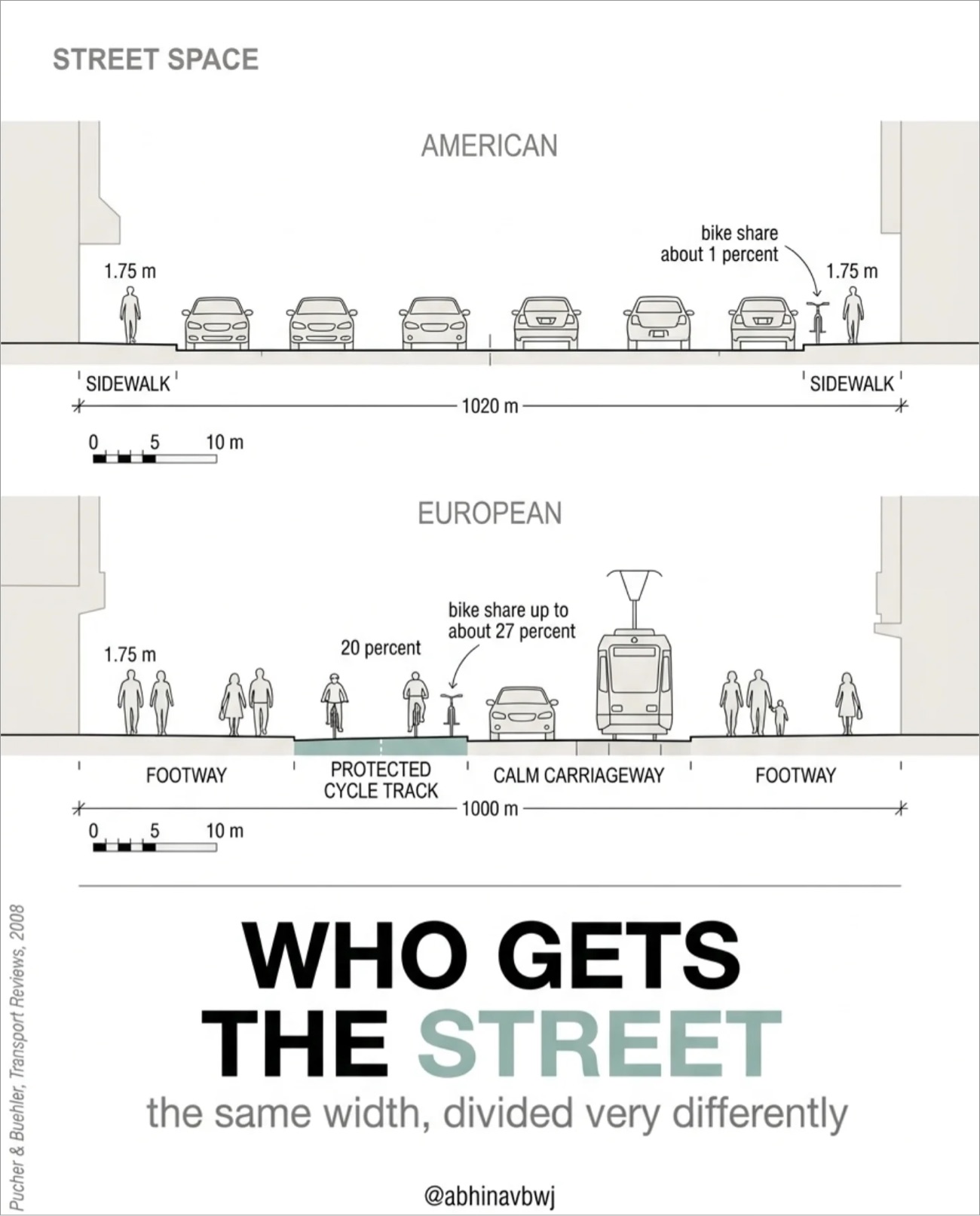
Architect and urban & computational designer Abhinav Bhardwaj made this great set of slides comparing urban design in the US and Europe, peppered with pithy observations like:
- European space is shaped on purpose: American open space is what’s left over.
- Small blocks make more corners, more routes, more street life.
- A fine grid offers hundreds of routes; the tree offers one way out.
The 1000 m and 1020 m for the width of the street seem off.
You don’t have 1 km wide streets in your city? Maybe it was supposed to be 100 m, but that still seems very wide. Maybe 1000", that would be around 25 m and fits better for regular inner city streets.
The depiction shows a 6+ lane street like, e.g. the city ring street of a large city.
Which is more like 35-50 m, at least for a european city.
You’re right.
They gotta be thinking 100 m and 102 m. They added an extra zero for some reason?
1.75 m is the height of the person labeled for scale, so if you turn them sideways it would take 57 people drawings to equal 100 m. But in the drawing only about 20 sideways people can fit. So it can’t just be an extra 0 added
You right, you right
If you take the 10 m scale below as a measure, the person would be 5 m tall and the 100(0) m would be ~50-60 m.
Yeah at a bare minimum the numbers in this drawing are all completely totally wrong. Is this an AI drawing?
As the cited paper is from 2008, I was tempted to say no. However, only the relative shares of the modes of transport are from the article, not the graphic itself.
So yes, this is likely an AI generated graphic.
https://www.researchgate.net/publication/292752103_Making_cycling_irresistible_Lessons_from_europe
One cited paper is from 1889, predating this whole graphics style by about a century. The graphics are probably what an AI made as a response to “illustrate this text passage” or “redraw this figure as vectors”. (Yes, this one probably generates vectors, otherwise the font families would be inconsistent within images, not just between them)
Fuckin hell.
What person would label a human as “1.75 m”? We know what a “human for scale” is. Also, every single graphic, despite credited to the same author, uses a different scale marking: zebra, bar, tick, snaking (and then ignores it). The fonts differ too (look at every capital R) but oddly not within drawings, it seems to be an AI optimized for vector output.
Almost no streets are 100 m wide. Maybe it was originally in inches and the author didn’t bother to convert units?
1000 x 0.0254 yields about 25.4 m, which would be pretty reasonable. Let’s assume that all lanes are 4 m wide, which would be much more than normal. (Usually, they’re closer to 3 m wide each, which would yield about 20 m; 2 m is included for the kerbs to separate traffic).
Then with 6 lanes (2 mainwalks, 2 bicycle lanes, 1 car lane + carriageway), you’d have 24 m. Give 1.4 m for some kerbs and then you get the 25.4 m.
@zaphod@sopuli.xyz , @Successful_Try543@feddit.org , I think I have the answer.^
Not all streets are like that, by the way. All of them have side/mainwalks, but not all have the other lanes. Within European cities, the streets are usually closer to 10 m wide.
You right, 100 meters isn’t reasonable. I’ve had about 3h of sleep in the last 48 or so, so my brain is a bit mush. 😆
tbf katy freeway is over 100m wide in some parts. but hopefully that is rare, and probably is ‘unreasonable’.
Those dudes need some more trains over there.
Fun facts: The Katy Freeway goes to Katy, Texas, and Katy, Texas is a southern terminus of the Katy Railroad (formally the Missouri, Kansas and Texas railroad, or “MKT”). The Katy was a major passenger railroad once upon a time.
So in a way, the freeway is helping motorists get to the trains, just trains that are in the past.
That’s a freeway though, I suppose.
sib??? get some sleep dawg
Sib?
Yeah I slept well this night. No worries. 😊
Not here to defend North American urban planning, but these diagrams make absolutely no sense. Also, both Europe and the Americas are highly diverse and cannot be generalized so easily.
Yup, definitely dealt with a depressing amount of car-only infrastructure on my trip through eastern Europe, even in cities with trams in some spots. I’d call the European diagram in the link the “European ideal” that cities try to strive for, and that north / western European places with lots of money are more often able to achieve than elsewhere on the continent.
But still makes you think. Europeans live closer together, way less space, but still use less space-efficient layouts. Sure, mostly not on purpose, grown that way over centuries. While industry quarters are closer to the american layout, less nice to walk.
I don’t think it’s great to generalize about “Europe” like this, but the points are still solid.
I still don’t understand why they labeled these streets as A THOUSAND METERS WIDE @.@
I don’t know. I don’t see any grids in Europe. Mostly, streets are named for the place they go to, so really just one way to get there unless you want to go way around
Tons of cities have grids, just maybe small ones. A theme in many places is to have an old downtown that has organic streets and a new downtown with a square grid, and then everything else is just a mess of straight and organic shapes.
Nearly all American cities are grids, so I don’t know what was trying to be said unless they’re just talking about suburban subdivisions
It honestly makes a lot of sense. Europe has a lot of urban fabric, which was build before the car. In most other continents, that is not the case, as urbanization happened later. That is not to say they do not have old cities, but for example a city like Bejing doubled in population since 1990. So a lot of urban fabric is actually new.
Am I just not comprehending that first image? Are they saying that streets are 1km wide? And if we use the scale key, are they saying the average car is 5m wide?
The numbers are likely ai bullshit. The original image is from a published paper that didn’t have numbers on the graphic
AI vector redrawing of a graphic in the cited paper. One paper is from 1889, predating this graphic style by about a century.
To be clear, the European example is not representative of your average city street here, they moreso represent an ideal to strive towards